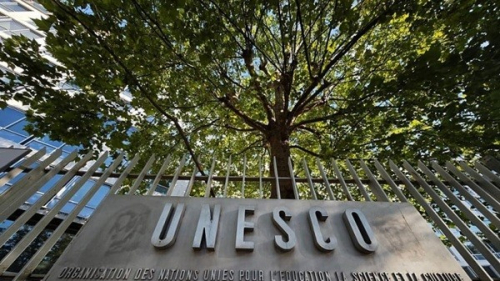
Sixty years in the making, the “General History of Africa” project has reached completion. UNESCO announced it has finished the final three volumes of the ambitious series, which was initiated in 1964 to tell the continent’s story from an African viewpoint, using indigenous sources.
The United Nations Educational, Scientific and Cultural Organization (UNESCO) announced the completion of its “General History of Africa” (GHA) project on Friday, October 17, at its Paris headquarters. The final three volumes, numbered IX, X, and XI, conclude the scholarly endeavor that began over sixty years ago to produce a history of the continent written primarily from an African perspective.
Volume IX updates the knowledge base accumulated since the first volumes were published in 1981. Volume X shifts focus to African circulations and presences abroad, examining the continent through the lens of its diasporas, from forgotten revolts in 9th-century Mesopotamia to more recent anchorings in Turkey, Iran, the Arabian Peninsula, and the Americas. Volume XI addresses contemporary Africa on a global scale, revisiting liberation struggles, the pursuit of unity and sovereignty, the dynamism and tensions of Pan-Africanism, and assessing shared modern challenges, from demographics and urbanization to migration, public health, gender equality, and environmental justice.
Breaking the Mold: The First Eight Volumes
The GHA originated in the mid-1960s. In 1964, as the continent transitioned into the postcolonial era, UNESCO accepted an ambitious request from African states to produce a history of Africa written from the continent's viewpoint. Amadou Mahtar M'Bow, in 1979, famously articulated the goal, denouncing “the myths and prejudices” that had long concealed the continent’s true face. The intellectuals behind the project aimed not for a counter-history, but for a rebalancing based on rigorous evidence, from archives to oral traditions.
The GHA established a new methodology and a new narrative. A key feature was the full incorporation of oral traditions, elevating them beyond folklore to a central component of source criticism
For 30 years starting in 1964, UNESCO brought together major intellectual figures from Africa and around the world, including Djibril Tamsir Niane, Cheikh Anta Diop, Théophile Obenga, Ali Mazrui, and Gamal Mokhtar. Under the direction of a predominantly African scientific committee, 550 specialists wrote the first eight GHA volumes, covering ancient civilizations and more recent history. These volumes, published between 1981 and 1994, marked a decisive methodological break.
Their translation into a wide array of languages, including Kiswahili, Hausa, and Fula, highlighted a political and editorial choice: to ensure the GHA circulated beyond elite intellectual circles and became a widely accessible common good in libraries, campuses, and schools.
The GHA established a new methodology and a new narrative. A key feature was the full incorporation of oral traditions, elevating them beyond folklore to a central component of source criticism. Manuscripts in Arabic and Ajami became crucial material for writing social and political history. Archaeology, epigraphy, and historical linguistics provided support for analyzing continuities and ruptures. This painstakingly consolidated, multidisciplinary toolkit illuminated historical chapters previously deemed inaccessible due to a lack of sources generally accepted in the West, allowing Africa to speak through its own texts, vestiges, and memories.
The Final Phase and Crucial Educational Stakes
The second phase of the project was protracted. In 2009, the African Union called for the work to be extended to contemporary events. Beginning in 2013, a scientific committee chaired by Cameroonian archaeologist Augustin Holl paced the production, assembled the teams, and arbitrated theoretical and editorial choices, mobilizing over two hundred researchers. In 2018, UNESCO Director-General Audrey Azoulay relaunched the effort, providing the decisive momentum needed to reach completion. The resulting work is massive in scope, but its core mission remains clear: to tell Africa’s history from the perspective of Africans, recognizing that the continent's history did not stop with Volume VIII.
Earlier editions often failed to reach African universities, much less school libraries. The new volumes aim to correct this through online availability, translation, and the production of supporting pedagogical tools.
The project’s promoters have consistently engaged in self-criticism, most frequently citing the difficulty of distributing the volumes. Earlier editions often failed to reach African universities, much less school libraries. The new volumes aim to correct this through online availability, translation, and the production of supporting pedagogical tools. Education ministries across the continent and the African Union Executive Council are advocating for the GHA’s integration into national curricula.
The credibility of this ambition, however, hinges on practicalities: teacher training, local co-editions, funding for textbooks, and distribution logistics. Successful dissemination requires organization, and it is at this price that the GHA will avoid being confined to a small circle of specialists.
The GHA's success holds crucial importance that transcends collective ego. In the world’s youngest continent, education is a vital lever for social stability and economic value. Accurate, localized content, connected to African oral traditions and existing historical remnants, nurtures a sense of identity, fuels cultural industries, informs media, and strengthens diplomacy.
The GHA is more than a narrative; it represents a deliberate choice of historical proof methods, giving oral tradition its proper place in the continent’s history. Above all, it is an essential educational project. Editorial completion would be merely symbolic without a genuine shift toward its adoption in schools.
New Tools Launched to Integrate History into Schools
To facilitate this adoption, UNESCO unveiled the Curriculum Pathway Tool on Friday, October 17. The tool is designed for ministries, curriculum developers, and trainers, offering a clear framework to integrate the GHA from primary to secondary levels, complete with explicit learning objectives and assessment benchmarks. It provides accessible teachers’ guides, ready-to-use lesson plans, thematic files that cross-reference time periods, cultural areas, and major concepts, and a corpus of updated resources, including bibliography and iconographic materials.
The tool features variants to accommodate different teaching hours, student prerequisites, and linguistic contexts, ensuring integration into heterogeneous educational systems, in both urban and rural areas. The objective is to move this intellectual heritage beyond library shelves and into the classroom as a living, taught, discussed, and evaluated subject.
To reach young people where they learn and seek entertainment, UNESCO is complementing this effort with a digital component. “African Heroes,” a free downloadable video game, features ten emblematic figures, from Queen Nzinga to Toussaint Louverture and Zumbi dos Palmares.
To reach young people where they learn and seek entertainment, UNESCO is complementing this effort with a digital component. “African Heroes,” a free downloadable video game, features ten emblematic figures, from Queen Nzinga to Toussaint Louverture and Zumbi dos Palmares. The game is not intended to replace textbooks, but to provide a compelling engagement tool adapted to contemporary student habits. UNESCO is aiming for real, measurable, and lasting appropriation. If states embrace it, if publishers continue the effort, and if teachers adopt the content, the promise made in 1964 can move from intention to daily practice. It is at that point, on classroom blackboards and smartphone screens, that the “General History of Africa” will fully accomplish its mission.
Servan AHOUGNON